For runners, cyclists, triathletes & golfers 40+
Train with your body clock, not against it.
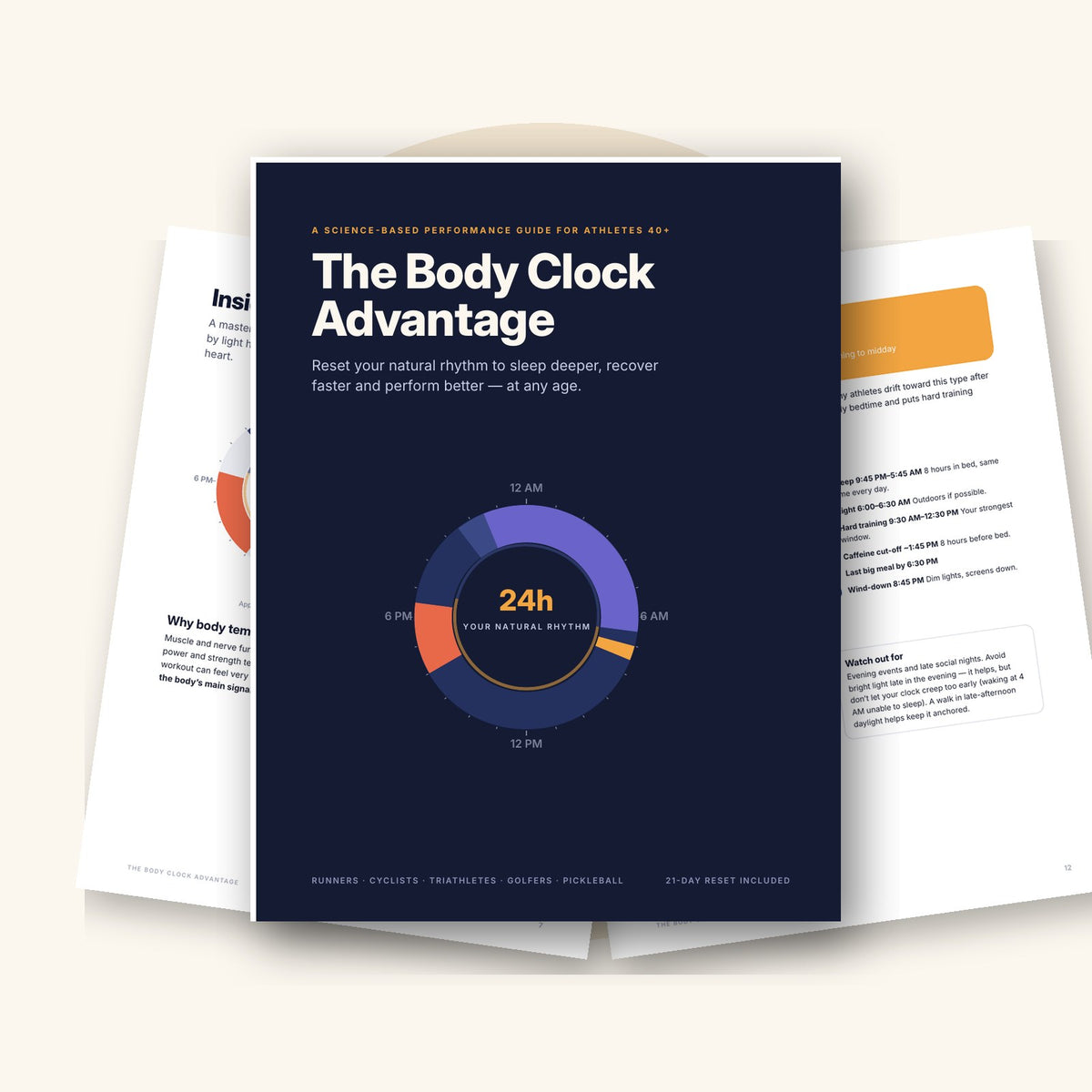
A science-based visual guide for athletes over 40: sleep deeper, recover faster and perform better by fixing the timing of what you already do.
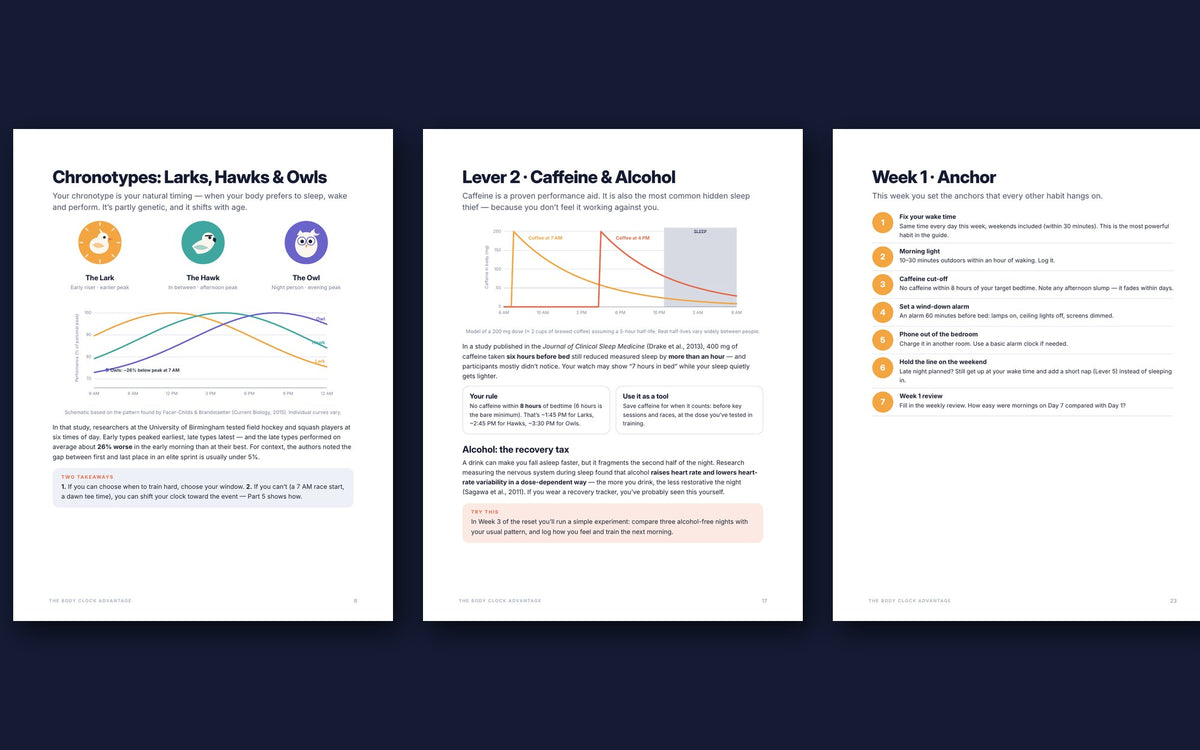
- Discover your chronotype: Lark, Hawk or Owl
- Your ideal day mapped on a 24-hour clock
- A simple 21-day reset, one small action a day
Instant PDF download · 36 pages · 30-day money-back guarantee
Sound familiar?
Your watch says you slept 7 hours. So why do you feel wrecked on your 6 a.m. run?
After 40, three things quietly change — and most training plans ignore all of them.
Less deep sleep
The stage most linked to physical repair declines steadily with age.
More wake-ups
Sleep gets lighter and more fragmented, so “7 hours in bed” isn’t 7 hours of recovery.
A shifting clock
Your rhythm drifts earlier, so badly timed training, caffeine or alcohol costs you more than it used to.
The connection
Recovery happens at night. Performance shows up in the morning.
Every hard session is only as good as the sleep that follows it. Get the timing right and your body repairs, adapts and shows up stronger.


Built on real research
Timing is the performance variable nobody manages
Step 1 · Find your type
Are you a Lark, a Hawk or an Owl?
A 2-minute quiz reveals your chronotype. Then you get a full daily blueprint built around it: when to get light, train hard, stop caffeine, eat and wind down.
What’s inside
36 visual pages. Zero fluff.
The Science, simply
How your 24-hour clock shapes strength, alertness and recovery — in 15 minutes.
The 5 Levers
Light, caffeine & alcohol, temperature, training time and naps, each with a clear visual guide.
The 21-Day Reset
Anchor → Align → Amplify. One small action a day that turns the science into habit.
Race-day protocol
How to arrive at a 7 a.m. start with your clock on your side — even if you’re an Owl.
Travel & jet lag
How many days you need per time zone, and how to adapt faster east or west.
Read your watch data
What Garmin, Apple Watch, Oura and Whoop get right about sleep — and what they don’t.
Step 2 · The 21-Day Reset
Three weeks. One small change a day.
Fix your wake time, get morning light, set your caffeine cut-off and wind-down.
Move hard sessions into your peak window and tune your bedroom and evening routine.
Extend your sleep, test naps and alcohol-free nights, and rehearse race-day timing.
This guide is for you if…
- You’re 40+ and train for running, cycling, triathlon, golf, tennis or pickleball
- You recover slower than you used to
- You track your sleep but don’t know what to change
- You want better timing, not more supplements or gadgets
30-day money-back guarantee
Read it, try the 21-day reset. If it isn’t useful to you, email us within 30 days of purchase and we’ll refund you in full. No hoops.
Questions
How do I get the guide?
Right after checkout you’ll get a download link on the confirmation page and by email. It’s a PDF that works on phone, tablet and computer, and you can print the tools.
I’m not an elite athlete. Is this for me?
Yes. It’s written for amateur athletes over 40 with jobs, families and early alarms. Every recommendation is adapted to real life.
Do I need a sleep tracker or supplements?
No. A tracker can help you see trends, and the guide shows you how to read it, but everything works without one. There’s nothing else to buy.
I already sleep 7 hours. Will this help?
Often, yes. The guide is about timing as much as quantity: when you get light, train, drink coffee and wind down relative to your own clock.
Is this medical advice?
No. It’s an educational guide based on published research. If you suspect a sleep disorder (loud snoring, breathing pauses, chronic insomnia), the guide explains the warning signs and why to see a doctor.
What if I don’t like it?
Email us within 30 days of purchase and we’ll refund you in full.
Stop fighting your body clock. Start training with it.
Your next 21 days of training can recover better than the last 21.
Instant PDF download · 36 pages · 30-day money-back guarantee
Educational content only — not medical advice. Results vary. Consult your doctor if you have a sleep disorder or medical condition.